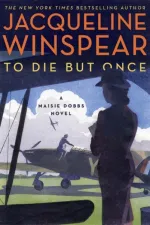
To Die but Once
During the Blitz, Maisie investigates the disappearance of a young apprentice painter whose work brought him into contact with military secrets.
Review
It is 1940, and London is enduring the Blitz. Against this backdrop of nightly terror, a frantic mother asks Maisie Dobbs to find her son Joe, a young apprentice sign painter who has vanished after being sent to work on a military contract in the countryside. What begins as a missing person case quickly reveals connections to wartime profiteering and the dangerous intersection of civilian labor and military secrets.
Winspear’s depiction of the Blitz is among the most vivid in the series. The nightly raids, the morning inspections of damage, the strange normality that people carve out between the bombs — all of it is rendered with a specificity that makes the period feel immediate rather than historical. The texture of daily life under bombardment gives the novel an urgency that propels even its quieter scenes.
Joe Coombes is a sympathetic figure whose youth and vulnerability give the investigation real emotional stakes. Through Maisie’s search, we learn about the world of apprentice painters — the chemicals they work with, the military installations they help camouflage, the secrets they cannot help but see. Winspear turns this specialized trade into a window onto the wartime economy and its exploitation of young workers.
The military dimensions of the case introduce a darker element. Someone powerful wants Joe’s disappearance to remain unexplained, and the obstacles placed in Maisie’s path suggest that national security is being invoked to cover something far less noble. Winspear handles this tension between patriotic duty and institutional corruption with characteristic subtlety.
Maisie’s role as an adoptive mother to Anna adds new layers to her character. The anxiety of raising a child during the Blitz — the evacuations, the shelters, the impossible calculations about safety — runs through the novel like a second heartbeat. Winspear draws convincing parallels between Joe’s mother’s desperate search and Maisie’s own fears for Anna.
Billy Beale’s son is serving in the military, and his worry provides another lens through which Winspear examines the cost of war on families. The home front is not a safe place in this novel — it is its own battlefield, with its own casualties and its own moral compromises.
The resolution ties together the personal and the political in a way that is both satisfying and sobering. The title, drawn from a line of poetry, resonates with the novel’s meditation on sacrifice — who is asked to give their life, and whether those in power honor that sacrifice or exploit it.
This is a strong wartime entry in the series, grounded in the lived reality of the Blitz and animated by Winspear’s deep compassion for ordinary people caught in extraordinary circumstances.