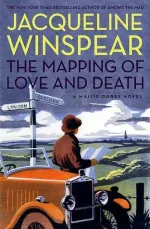
The Mapping of Love and Death
An American cartographer's remains are discovered on a Great War battlefield, and Maisie is hired by his parents to learn the truth about his death.
Review
The discovery of an American cartographer’s remains on an old Great War battlefield sets Maisie Dobbs on one of her most emotionally resonant investigations. Hired by the young man’s grieving parents, who have traveled from California to England, Maisie must reconstruct the final months of a life cut short and determine whether his death was enemy fire or something more personal.
Winspear’s dual-timeline structure is particularly effective here. The cartographer’s wartime letters and maps provide a window into his experience at the front, while Maisie’s present-day inquiries reveal how the war continues to distort the lives of those who survived. The mapping metaphor runs elegantly through both narratives — charting terrain, charting relationships, charting the distance between truth and memory.
The American parents bring a fresh perspective to the series. Their outsider status in English society mirrors Maisie’s own position as a woman who moves between classes, and their raw grief stands in contrast to the English tendency to keep suffering private. Winspear writes their scenes with a tender directness that avoids sentimentality.
Maisie’s investigation takes her into the world of wartime cartography, and Winspear makes this specialized subject genuinely fascinating. The maps become both literal evidence and metaphorical commentary on the impossibility of truly knowing a landscape — or a person — shaped by war. The technical details never overwhelm the human story at the center.
A love affair discovered through the dead man’s letters adds another layer to the mystery. Winspear handles this thread with delicacy, allowing the romance to emerge gradually through fragments and silences rather than spelling everything out. The identity of the beloved becomes its own puzzle, intertwined with the question of who might have wanted the cartographer dead.
The novel also advances Maisie’s personal arc in meaningful ways. Her own romantic life faces new complications, and Winspear draws thoughtful parallels between the wartime love story and Maisie’s struggle to open herself to intimacy after years of self-reliance. These personal moments never feel forced — they arise naturally from the investigation itself.
The resolution is bittersweet, as is fitting for a story about a death that is over a decade old. Justice, in the conventional sense, is elusive, but understanding is not. Winspear suggests that mapping the truth of what happened may be the closest thing to peace that the living can offer the dead.
This is one of the strongest entries in the series, balancing mystery, history, and character with quiet assurance. It demonstrates why Winspear remains one of the finest writers working in historical crime fiction.