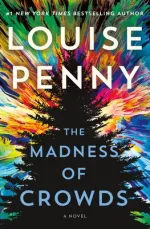
The Madness of Crowds
by Louise Penny
A controversial statistician gives a dangerous lecture in Three Pines, and Gamache must prevent a community's fear from turning into violence.
Review
Louise Penny’s seventeenth Gamache novel tackles one of the most difficult themes in contemporary fiction: how fear and ideology can transform decent people into a mob. A controversial statistician arrives in Three Pines to deliver a lecture, and her ideas — about who matters and who doesn’t — begin to poison the community from within.
The setup is deceptively simple but deeply unsettling. The statistician’s arguments are presented with enough intellectual polish to sound reasonable, which is exactly what makes them dangerous. Penny understands that the most destructive ideas don’t announce themselves as evil; they arrive dressed in data and academic respectability.
Gamache faces a challenge that brute force and traditional policing cannot solve. How do you protect a community from an idea? How do you maintain order when the threat isn’t a person but a way of thinking that turns neighbours against each other? These questions drive the novel with genuine philosophical weight.
The Three Pines residents are split in ways that feel painfully authentic. Old friends find themselves on opposite sides, and Penny captures the specific anguish of watching someone you love embrace something ugly. The village’s usual warmth curdles into suspicion and hostility, and it’s genuinely uncomfortable to read.
Penny writes about crowd psychology with nuance and evident research. The escalation from polite disagreement to dangerous confrontation unfolds in stages that feel both surprising and inevitable. Each step makes sense in the moment, which is precisely how mobs form in the real world.
The murder, when it comes, feels almost secondary to the larger social catastrophe unfolding in Three Pines. But Penny is too skilled a mystery writer to let the whodunit slide. The investigation reveals connections between the killing and the community’s fractures that deepen both storylines.
Gamache’s leadership is tested in new ways here. His instinct is always to understand, to empathise, to find common ground. But what happens when understanding itself becomes a weapon, when empathy is exploited by those arguing in bad faith? It’s the kind of moral knot Penny excels at tying.
A brave and timely novel that uses the cosy crime framework to explore how quickly civilisation can unravel when fear takes hold. Penny doesn’t offer easy answers, but she insists that asking the right questions matters.