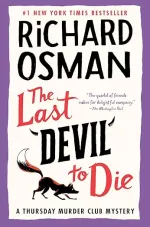
The Last Devil to Die
When a beloved friend is murdered over an antique worth millions, the club must track a killer while grappling with loss and mortality.
Review
The fourth Thursday Murder Club novel is the most emotional entry in the series. When Kuldesh Sharma — a beloved antiques dealer and friend to the group — is murdered over a mysterious item worth millions on the black market, the club’s investigation becomes deeply personal. This is not just a case to solve; it is a reckoning with grief, and Osman handles it with remarkable grace.
The mystery itself involves drug trafficking, a valuable stolen artifact, and a chain of increasingly dangerous criminals. Osman constructs the plot with his usual skill, layering misdirection and genuine surprises throughout. The pacing is excellent, with revelations arriving at precisely the right moments to keep the pages turning.
Elizabeth’s storyline reaches its most vulnerable point here. The hints about her declining health that were threaded through the previous book become impossible to ignore, and watching this formidable woman confront her own limitations is genuinely heartbreaking. Osman refuses to sentimentalise her situation, which makes it all the more powerful.
Joyce steps up in ways that would have seemed unthinkable in the first book. Her quiet courage and emotional intelligence prove just as valuable as Elizabeth’s tradecraft or Ibrahim’s analysis. The evolution of her character across four books is one of the series’ finest achievements, and her diary entries here carry real weight.
Ibrahim faces the investigation with his customary rigour, but there is a tenderness to his scenes that reflects the group’s shared grief. His friendship with Kuldesh is sketched in flashbacks that make the loss feel genuine and specific rather than abstract.
Ron’s anger at the murder fuels some of the book’s most compelling moments. His determination to find justice for his friend is fierce and uncompromising, and it drives the plot forward when the investigation threatens to stall. He is the engine of the group’s resolve, and his scenes crackle with energy.
The supporting cast is strong as ever. Chris and Donna are given their most substantial arcs yet, with personal and professional stakes that intertwine with the main mystery in satisfying ways. New characters are introduced with Osman’s characteristic efficiency — vivid and memorable in just a few strokes.
What makes this book stand apart is its willingness to sit with sorrow. The Thursday Murder Club has always acknowledged that its characters are in the final stretch of their lives, but here that awareness moves from subtext to centre stage. The result is a novel that is funny, thrilling, and profoundly moving — the best in the series and a testament to Osman’s growth as a storyteller.