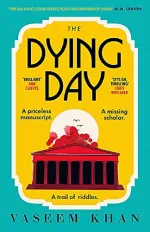
The Dying Day
by Vaseem Khan
A priceless six-hundred-year-old manuscript vanishes from the Bombay Asiatic Society, and its guardian is found dead in a locked room.
Review
Vaseem Khan’s second Malabar House novel opens with an irresistible premise: a priceless copy of Dante’s Divine Comedy, one of the oldest illustrated manuscripts in existence, has vanished from the Bombay Asiatic Society. Its custodian, a British scholar, is found dead in a locked room. Inspector Persis Wadia is handed the case that nobody else wants to touch.
The locked-room element gives the mystery an almost classical detective fiction flavour, and Khan executes it with real flair. The puzzle is genuinely satisfying — the kind that rewards careful attention while still managing to surprise. How the manuscript disappeared and why the scholar had to die are questions that pull you through the pages with mounting urgency.
Persis continues to be a magnificent protagonist. In this instalment she faces not only professional resistance but also the complications of a tentative romantic subplot that Khan handles with admirable restraint. She remains fiercely independent, and watching her navigate both a complex case and the expectations of 1950s Indian society is endlessly compelling.
The world of Bombay’s literary and academic elite provides a rich backdrop. Khan takes us inside institutions where colonial attitudes persist despite independence, where knowledge is power and manuscripts are worth killing for. The contrast between the rarefied world of rare books and the gritty reality of police work creates a productive tension throughout.
Khan deepens the supporting cast considerably here. The officers at Malabar House begin to emerge as individuals with their own stories and motivations. Archie Blackfinch, the British forensic scientist, becomes a more rounded figure, and his awkward partnership with Persis develops in ways that feel organic rather than forced.
The historical context remains one of the series’ greatest strengths. The early years of Indian independence were messy, hopeful, and fraught with contradiction, and Khan captures all of that complexity without ever losing sight of the central mystery. Politics and policing are inseparable in this world, and Persis must navigate both.
The pacing improves on the first book. Khan has found his rhythm, knowing exactly when to accelerate the plot and when to pause for character development or atmospheric detail. The middle section, which could have sagged under the weight of investigation, instead builds steadily toward a gripping conclusion.
There is a wonderful sequence involving the manuscript’s history that reads almost like a story within a story. Khan traces the journey of Dante’s work across centuries and continents, and this literary archaeology adds a layer of depth that elevates the novel beyond standard crime fiction.
The resolution ties together multiple threads with precision. Khan demonstrates that he can handle increasingly complex plots without losing control, and the final reveal lands with both intellectual and emotional impact. Nothing feels wasted or arbitrary.
The Dying Day confirms that the Malabar House series is one of the most rewarding in contemporary crime fiction. It combines a superb detective, a fascinating historical setting, and genuinely clever mysteries in a way that very few series manage. This is crime writing at its most intelligent and atmospheric.