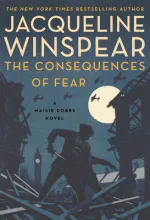
The Consequences of Fear
A young message runner for the French Resistance witnesses a murder on a London street, and Maisie must protect him while uncovering a wartime conspiracy.
Review
A young French boy named Freddie Hackett, who works as a message runner between government offices, witnesses a brutal killing on a London street. When no body is found and the authorities dismiss his account, Maisie Dobbs takes the boy’s story seriously and begins an investigation that leads into the shadowy world of wartime intelligence and the French Resistance operations coordinated from London.
Freddie is one of Winspear’s most appealing creations — a child of mixed heritage who lives between two cultures and two languages, navigating the dangerous streets of wartime London with a courage that belies his age. His vulnerability gives the novel real stakes, and Maisie’s protective instinct toward him connects to her ongoing experience as Anna’s mother. Winspear writes children with a respect that never shades into sentimentality.
The wartime intelligence world is rendered with convincing complexity. The various agencies — British, French, Free French — operate with overlapping jurisdictions and competing agendas, and Maisie must navigate a landscape where allies may be more dangerous than enemies. Winspear handles this bureaucratic maze without ever losing the reader, grounding the political intrigue in personal relationships and concrete details.
The theme of fear runs through every level of the novel. Freddie’s fear of not being believed, Maisie’s fear for those she loves, the pervasive fear of the Blitz, and the deeper fear that the war may be unwinnable — all of these are explored with Winspear’s characteristic sensitivity. The title refers not just to what fear produces but to what it costs, and the consequences are distributed unevenly across class, age, and nationality.
Maisie’s relationship with Mark Scott continues to develop, and the complications of loving someone involved in intelligence work add personal tension to the professional challenges. Winspear gives their relationship the same careful, unrushed treatment she brings to her mysteries, allowing it to deepen through shared experience rather than dramatic declarations.
The connection to the French Resistance adds historical richness to the narrative. Winspear shows the extraordinary courage of those who organized resistance from London while their homeland suffered under occupation, and she does not shy away from the moral ambiguities involved — the sacrifices demanded, the people expendable in the larger cause.
The resolution of the mystery ties together the personal and political threads with satisfying precision. The truth about what Freddie witnessed turns out to be both more complicated and more human than anyone anticipated, and the final chapters deliver both justice and the unsettling recognition that justice in wartime is always incomplete.
This is a finely crafted entry in the series that uses a child’s terrified testimony as the starting point for a layered exploration of courage, loyalty, and the human cost of clandestine warfare.