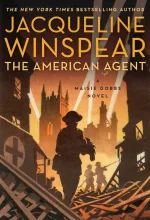
The American Agent
An American war correspondent is murdered during the London Blitz, and Maisie must navigate wartime secrecy and Anglo-American tensions to find the killer.
Review
Catherine Saxon, an American journalist reporting on the London Blitz for an American audience, is found murdered in her flat. The case is politically sensitive — America has not yet entered the war, and any mishandling could damage the fragile relationship between the two nations. Maisie Dobbs is brought in to work alongside an American agent from the Department of Justice, and the partnership proves as complicated as the case itself.
Winspear captures the peculiar dynamics of 1940, when Britain desperately needed American support but could not appear to be begging for it. The American correspondents in London occupy an ambiguous position — sympathetic witnesses whose reporting might sway public opinion, yet also outsiders whose presence is a reminder that America is watching rather than fighting. This tension runs through every scene.
Catherine Saxon is vividly drawn through the testimony of those who knew her. She was brave, ambitious, and determined to make Americans understand the reality of the Blitz through her dispatches. Winspear gives us enough of her personality to feel the genuine loss, not just the political inconvenience, of her death. The fragments of her writing that surface during the investigation are particularly effective.
The partnership between Maisie and the American agent creates productive friction. Their different methods, different assumptions about authority, and different relationships to the war generate scenes that are by turns tense, funny, and revealing. Winspear uses their dynamic to explore larger questions about national character without reducing either to a stereotype.
The Blitz continues to provide a relentless backdrop, and Winspear does not let the reader forget that every character is living under the constant threat of death from above. The nightly raids shape the investigation in practical ways — witnesses are killed, evidence is destroyed, neighborhoods are rearranged overnight — and this instability gives the plot a distinctive rhythm.
Maisie’s personal life is woven in with a lighter touch than in some recent entries. Her relationship with Mark Scott develops naturally, and Winspear resists the urge to force the romantic subplot into the foreground. Anna continues to be a grounding presence, a reminder of what Maisie is protecting even as she pursues dangerous truths.
The solution to the mystery is satisfyingly complex, involving layers of political calculation and personal motive that intertwine in ways that feel both surprising and inevitable. Winspear reminds us that even in wartime, when death is everywhere, individual murder retains its capacity to shock and its demand for justice.
This is a confident, politically astute entry in the series that uses the murder of one woman to illuminate the larger drama of nations on the brink. Winspear writes the Anglo- American relationship with the same nuance she brings to her characters, and the result is one of the series’ most engaging novels.