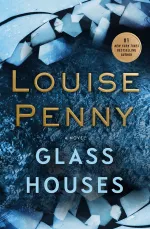
Glass Houses
by Louise Penny
A mysterious masked figure appears on the village green, and Gamache must make an impossible choice between justice and the law.
Review
Louise Penny’s thirteenth Gamache novel opens with an image that lingers long after you close the book: a dark, robed figure standing motionless on the Three Pines village green, wearing a terrifying mask. Nobody knows who it is. Nobody knows what it wants. The village watches and waits, and so does the reader.
The novel unfolds on two timelines — the events in Three Pines and a courtroom drama months later where Gamache himself is on trial. Penny braids these threads with real confidence, using the trial scenes to ratchet up tension around what exactly happened in the village and why Gamache made the choices he did.
At the heart of the book is a moral dilemma that has no clean answer. Gamache must decide whether to uphold the letter of the law or pursue a deeper justice, knowing that either path will cost him something precious. Penny refuses to simplify this, and the result is one of the most thought-provoking entries in the series.
The opioid crisis threads through the story with quiet devastation. Penny doesn’t lecture or sensationalise; she simply shows the damage through characters we’ve come to care about. The drugs arrive in Three Pines not through dramatic action sequences but through the ordinary channels of human weakness and desperation.
Gamache is at his most complex here. The patient, humane detective we know is pushed to his limits, forced into decisions that look reckless or even corrupt from the outside. Penny trusts the reader to hold judgement, to wait for the full picture, and the payoff is worth the patience.
The courtroom scenes are surprisingly gripping for a cosy crime novel. Penny handles legal procedure with a light touch, keeping the focus on character and consequence rather than procedural detail. The tension comes not from whether Gamache is guilty but from understanding why he did what he did.
Three Pines itself feels both familiar and unsettled in this installment. The masked figure disrupts the village’s equilibrium in ways that go beyond the immediate mystery, forcing residents to confront their own fears and prejudices. Penny uses this beautifully to explore how communities respond to the unknown.
A bold and structurally ambitious entry that rewards longtime readers while raising the stakes for the series. Penny proves that cosy crime can wrestle with the thorniest moral questions without losing its warmth.