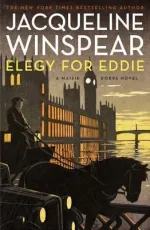
Elegy for Eddie
The death of a gentle horse whisperer in a Lambeth factory leads Maisie to confront press barons and the growing shadow of Oswald Mosley.
Review
Eddie Pettit was a simple man with an extraordinary gift for calming horses, beloved in the Lambeth streets where Maisie Dobbs grew up. When he dies in what is ruled a factory accident, the women of the neighborhood refuse to accept the verdict and ask Maisie to investigate. What follows draws her into the world of press barons, political manipulation, and the frightening momentum of Oswald Mosley’s Blackshirts.
Winspear’s decision to root this story in Maisie’s childhood neighborhood gives it an emotional immediacy that some earlier entries in the series lack. Maisie is not investigating strangers here — she is walking streets she once walked as a child, talking to people who knew her father. The personal stakes sharpen every scene and give her determination a raw, almost desperate quality.
Eddie himself is a beautifully drawn character, present mostly through the memories of those who loved him. His gentleness and vulnerability stand in stark contrast to the powerful men whose interests his death seems to serve. Winspear makes us feel his loss without resorting to sentimentality, building a portrait through small, specific details that accumulate into something deeply moving.
The investigation leads Maisie into the corridors of media power, where newspaper proprietors shape public opinion and political movements with casual ruthlessness. Winspear draws clear parallels to modern media concentration without becoming heavy-handed, letting the historical details speak for themselves. The press barons are rendered as complex figures — charming, intelligent, and genuinely dangerous.
The shadow of Mosley’s fascist movement hangs over the entire novel. Winspear shows how economic desperation and national humiliation create fertile ground for extremism, and she does so through the lived experience of ordinary people rather than through political speeches. The Lambeth residents who consider attending Blackshirt rallies are not villains — they are frightened and angry, looking for someone to blame.
Maisie’s personal life continues to evolve, and this novel marks a significant turning point in her emotional journey. Her relationship with James Compton deepens in ways that challenge her carefully maintained independence, and Winspear handles these scenes with a maturity that respects both characters.
The resolution of the mystery is satisfying if not entirely surprising, but the real power of the book lies in its elegy for a vanishing world — the close-knit working-class communities being swept away by economic change and political upheaval. Eddie’s death becomes a symbol of something larger and irretrievable.
This is Winspear at her most politically engaged, using a murder mystery to illuminate the forces that were reshaping Britain in the early 1930s. It is also among her most emotionally affecting novels, grounded in a community that feels utterly real.