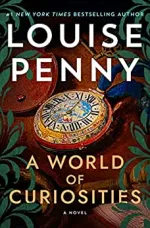
A World of Curiosities
by Louise Penny
Two troubled children from Gamache's first case resurface as adults, bringing unresolved trauma and fresh danger to Three Pines.
Review
Louise Penny reaches back to the very beginning of the series with her eighteenth Gamache novel. Two children connected to Gamache’s first homicide case reappear in Three Pines as damaged adults, carrying years of unresolved trauma and threatening to unravel the fragile peace of the village.
The premise is a gift for longtime readers. Penny rewards the investment of following the series by drawing direct lines between past and present, showing how the consequences of violence ripple outward across decades. Even casual actions leave marks that time doesn’t erase.
The returning characters are drawn with Penny’s usual psychological acuity. They arrive in Three Pines not as simple victims or villains but as complicated people shaped by terrible circumstances. Penny’s compassion extends even to those who make destructive choices, without excusing the destruction they cause.
Gamache confronts the limits of his own influence in this installment. He tried to help these children years ago, and the question of whether he did enough — whether anyone could have done enough — haunts every interaction. It’s a mature exploration of responsibility and the gap between intention and outcome.
The mystery itself is tightly constructed, with clues embedded in both the present investigation and the historical case. Penny plays fair with the reader, planting information that only makes sense in retrospect. The solution, when it arrives, carries emotional weight that goes beyond the simple satisfaction of puzzle solving.
Three Pines serves as both sanctuary and catalyst in this story. The village’s openness, its willingness to absorb newcomers, is tested when the newcomers bring genuine danger. Penny uses this tension to explore whether compassion has limits and what happens when it does.
The supporting cast continues to evolve in satisfying ways. Ruth’s acerbic wisdom, Clara’s generous heart, and Myrna’s steady insight all play essential roles. These aren’t background characters going through familiar motions; they’re people who grow and surprise even eighteen books into the series.
A resonant entry that proves the value of long-form storytelling. Penny uses the accumulated weight of the series to deliver emotional payoffs that a standalone novel simply couldn’t achieve.