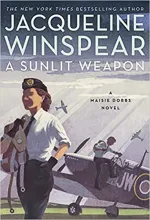
A Sunlit Weapon
A female pilot with the Air Transport Auxiliary is shot at while landing, and Maisie's investigation reveals dangers both in the sky and on the ground.
Review
When a pilot with the Air Transport Auxiliary is shot at while landing her aircraft near Maisie Dobbs’ country estate, the investigation draws Maisie into the world of women who fly military planes across Britain. It is 1942, and these pilots — ferrying Spitfires, Hurricanes, and bombers from factories to airfields — are performing essential and dangerous work that few outside the military know about.
Winspear’s portrayal of the ATA women is one of the novel’s great strengths. These are pilots who fly without radios, without weapons, and often without adequate maps, navigating by landmarks in all weather conditions. Their courage and competence are rendered without fanfare, and Winspear lets the extraordinary nature of their work speak for itself. The flying scenes carry a genuine thrill that is new to the series.
The shooting incident opens into a wider investigation that connects to displaced persons, wartime prisoners, and the complex politics of an estate that has been requisitioned for military use. Winspear builds the plot through accumulation, layering seemingly unrelated threads until their connections become clear. The Kent countryside, so often a peaceful backdrop in the series, takes on an unfamiliar menace.
Maisie’s estate at Chelstone serves as both setting and symbol. The requisitioned land, the military presence, the disrupted rhythms of rural life — all reflect the way the war has reached into every corner of English existence. Winspear uses the domestic scale to illuminate the larger conflict, a technique she has refined throughout the series.
Anna’s presence continues to enrich the narrative. Maisie’s anxieties as a mother in wartime are never far from the surface, and the relationship between them is drawn with a warmth that provides emotional ballast for the darker elements of the story. Winspear writes motherhood as an ongoing negotiation rather than a settled state, which feels honest and true.
The mystery involves American servicemen stationed nearby, adding another layer of Anglo-American tension to the narrative. Winspear handles the cultural collisions with humor and insight, showing how the presence of a foreign army on English soil created friction and camaraderie in equal measure. The American characters are drawn with specificity rather than caricature.
The resolution brings together the personal and political strands with Winspear’s characteristic precision. The identity of the shooter and the reasons behind the attack prove to be rooted in the dislocations of war — people uprooted, identities fractured, loyalties tested beyond endurance.
This is a richly textured entry in the series that celebrates the unsung heroism of the ATA women while delivering a satisfying mystery. Winspear’s ability to find new stories within the familiar framework of wartime Britain remains remarkable.