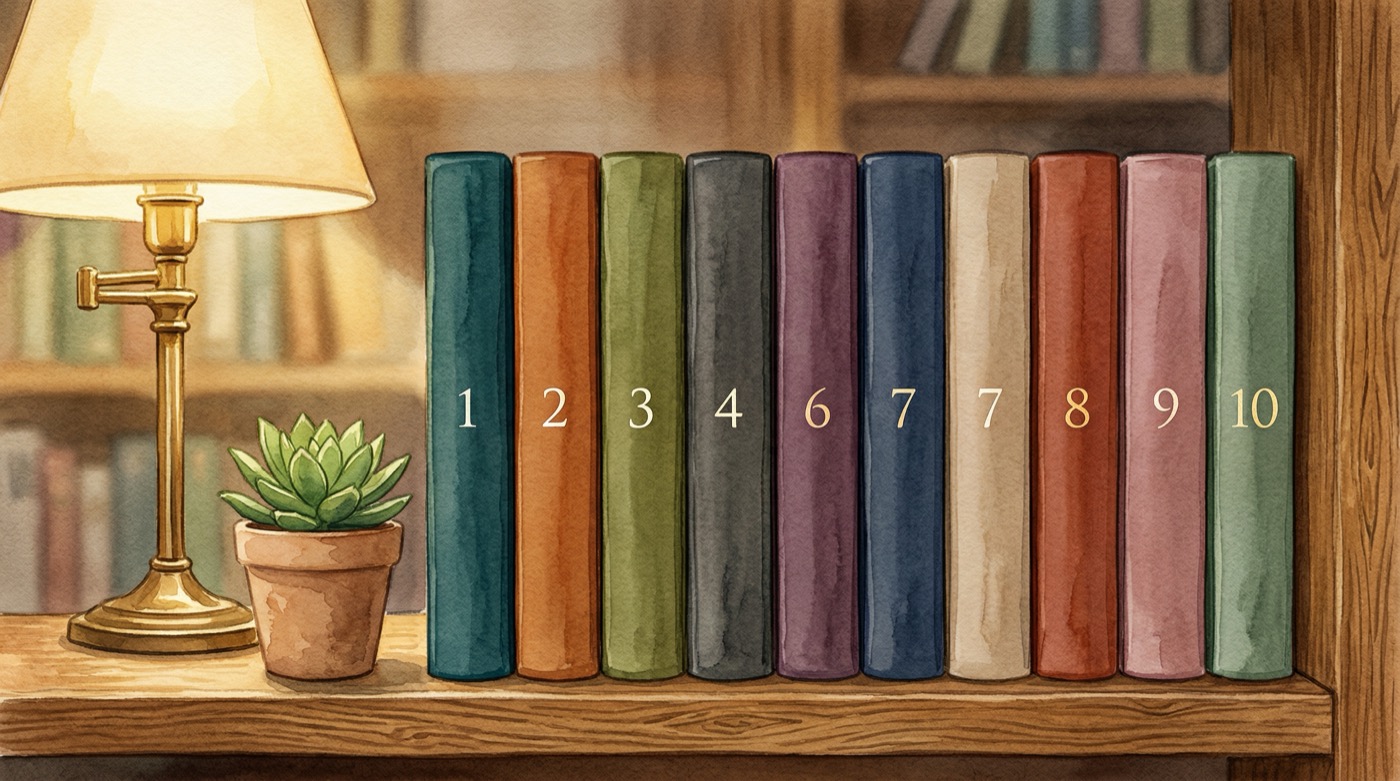
Why Reading Order Matters More Than You Think
There is a particular kind of reader who picks up book seven of a beloved mystery series because someone pressed it into their hands at a party and said “you have to read this one.” And honestly? Sometimes that works out fine.
But sometimes you find yourself halfway through wondering why everyone seems to know each other so well, why a character’s grief feels heavier than the book itself explains, why a joke lands with an emotional resonance you cannot quite account for. You are missing something, and you do not know what.
That is reading order doing quiet, invisible work.
This is not a lecture. If you have read every Chief Inspector Gamache book out of order and loved them all, good. If you skipped straight to book four of Maisie Dobbs because the cover caught your eye, we are not here to take that away from you. But we do want to make the case — gently, with specific examples — that reading in order is not a rule. It is a gift you give yourself.
Why does reading order matter for mystery series?
Cosy crime is built on accumulation.
Unlike thrillers, which often reset between books, or literary fiction, where standalone depth is the whole point, cosy crime series are designed to reward loyalty. The pleasure is cumulative. You are not just solving a murder alongside Chief Inspector Gamache — you are watching him age, doubt himself, rebuild trust, lose people he loves, and slowly become the man the village of Three Pines needs him to be.


Louise Penny has said that she thinks of the Gamache series as one long novel. That is not marketing language. It is structurally true. The emotional payoff of the later books depends on everything that came before. A betrayal in book six means nothing if you have not watched that relationship form across five earlier novels. A reconciliation in book twelve is devastating — in the best way — only if you remember what was broken.
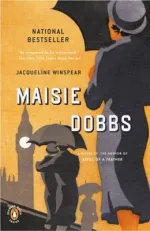
The same logic applies to Jacqueline Winspear’s Maisie Dobbs series. Maisie is a psychologist and investigator working in the long shadow of the First World War, and her character arc across the series is one of the most carefully constructed in the genre. Each book peels back another layer of her trauma and her strength. Pick up book five and you will meet a competent professional. Start from the beginning and you will understand what it cost her to become that person.
That understanding is the difference between reading a good mystery and being genuinely moved by one.
When is it okay to read out of order?
Honestly? More often than you might think.
Some series are loosely connected rather than tightly serialised. Each book solves a self-contained mystery, and while characters recur and develop, the narrative does not depend on prior knowledge. You might miss texture, but you will not miss plot.
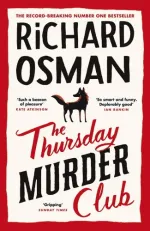
Richard Osman’s Thursday Murder Club is a reasonable example. The four residents of Coopers Chase are vivid enough to be introduced book by book, and Osman is careful to re-establish relationships without making seasoned readers feel lectured. Start with book three if a friend lends it to you — you will almost certainly enjoy it, then want to go back.
Similarly, if a series is genuinely episodic — where each mystery is its own island and the detective barely changes — order matters much less. Some golden-age-style cosies are written explicitly this way, and there is real pleasure in that kind of reading too.
The honest truth is this: the question is not whether you can read out of order, but what you will get from doing so. For some series, very little is lost. For others, a great deal.
What do you miss by skipping ahead?
The quick answer is: the slow burn.
And the slow burn is often the best part.
When you skip ahead in a series like Malabar House, you arrive at a more experienced, more battle-scarred Inspector Persis Wadia without having watched Vaseem Khan build her. You see who she has become without understanding who she was — the first female detective in post- independence India, navigating a world that expects her to fail, earning every inch of the ground she stands on. That journey is the series. The mysteries are almost secondary.
More specifically, here is what reading out of order tends to cost you:
Relationship development. The slow-building friendships, rivalries, and romantic tensions that cosy crime does better than almost any other genre depend on time. You cannot shortcut your way to caring about who ends up with whom, or why a partnership fractures, without the chapters that established what was there in the first place.
Earned grief. When a character dies or leaves in a well-constructed series, it is a genuine loss — for the detective and for the reader. That loss is diminished if you have not spent time with the person being mourned.
Authorial confidence. Most series improve across their run as writers find their voice and deepen their world. Starting at book seven, which is often sharper and richer than book one, is efficient. But it can make the earlier books feel lesser when you do eventually go back, which is unfair to work that was doing important foundation-laying at the time.
The accumulation of place. Three Pines is not just a setting. By book eighteen, it is a character. You have to spend time there to understand why it functions as both sanctuary and fault line.
How do authors build long-running series?
Not by accident.
The best long-running cosy crime series are designed with an architecture in mind — even if that architecture shifts and evolves as the author learns more about their characters. There is usually a distinction between the mystery plot (self-contained, resolved within the book) and the character arc (which unfolds slowly across the series as a whole).
Jacqueline Winspear has spoken about knowing, from quite early in the Maisie Dobbs series, where Maisie’s emotional journey was heading. The individual mysteries are carefully crafted, but they are also vehicles. They put pressure on Maisie in particular ways — grief, class, loyalty, love — because Winspear knows which buttons she needs to press at which points in the larger story.
Louise Penny does something similar with Gamache’s relationship to the institutions he serves. His faith in the Sûreté du Québec is gradually complicated, broken, and rebuilt in ways that track directly with his understanding of justice, power, and complicity. That is not a mystery plot. That is a novel-length character study wearing a mystery series as its coat.
Vaseem Khan’s Malabar House is operating in a compressed historical moment — the first years of independent India — which means the series has an inherent shape dictated by history itself. Reading in order is reading Persis alongside a country in formation, which gives both the detective and the reader a shared sense of possibility and uncertainty that cannot be replicated if you already know how things turn out.
Even Richard Osman, whose series is more gently episodic than these others, has constructed a slow-moving emotional core around Elizabeth and Stephen’s relationship — a love story being quietly, beautifully interrupted by dementia — that only lands with full weight if you have watched it unfold from the start.
What is the difference between publication and chronological order?
This is where things get genuinely complicated.
Publication order is the order in which the author released the books into the world. Chronological order is the sequence of events within the story’s internal timeline. For most series, these are the same thing — the author writes forward in time and publishes in that order.
But not always.
Prequels are the most obvious complication. Sometimes an author, deep into a successful series, writes a book set earlier in their detective’s life — before the main series began, or between two existing books. Should you read it in publication order (when it was released, interrupting the series) or chronologically (at the point in the narrative where it fits)?
Our general recommendation: publication order, unless the author explicitly says otherwise. Here is why. Authors write prequels knowing what their readers already know. The texture of a prequel — what it chooses to reveal, what it leaves in shadow, how it frames events — is often calibrated for readers who have come from the future of that world. Read chronologically, a prequel can feel thin or overly expository. Read after several mainline books, it resonates in ways the author intended.
There are exceptions, and where they apply we note them on the relevant series pages. But as a working principle, publication order is the order the author intended readers to experience the story, even when chronology would suggest otherwise.
The Maisie Dobbs series, for what it is worth, is a clean publication-equals- chronological case. Winspear writes forward in Maisie’s life, and the books move through the 1920s and 1930s without jumping around. The Malabar House series similarly tracks forward through the 1950s, grounding its readers in a period of history as much as in a character’s biography.
The simplest version of all of this is: reading in order is usually better, sometimes much better, and occasionally makes the difference between liking a series and being transformed by it.
We built Every Book In Order because we believe the slow accumulation of a long-running series is one of the underrated pleasures of reading — and because it is surprisingly hard to find clear, trustworthy reading orders without falling down a forum rabbit hole. Every series page on this site lists books in the order we recommend, with notes where publication and chronological order diverge.
Start at the beginning. Take your time. Three Pines will be worth it.